Beyond body mass index: obesity is a defended, multi-system disease
Body mass index endures because it is inexpensive and useful across populations, but it misdescribes disease in the individual. Recognising obesity as a heritable, biologically defended, multi-system disease is the precondition for treating the person rather than the number.
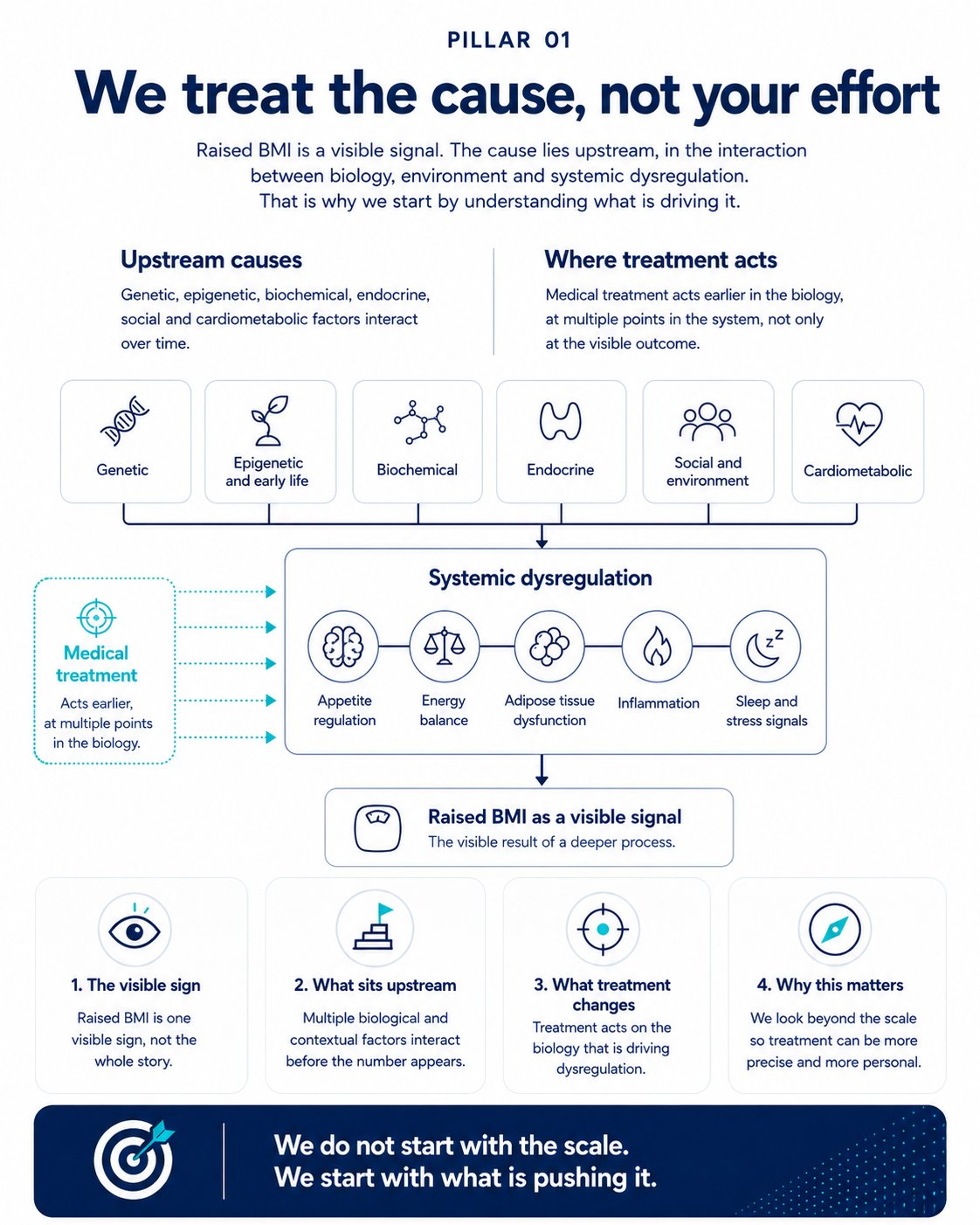
Raised BMI is a visible signal. The cause lies upstream, in the interaction between biology, environment and systemic dysregulation.
A statistic asked to do too much
Body mass index began as a nineteenth-century population statistic, devised by Adolphe Quetelet to describe the distribution of weight across groups rather than to diagnose illness in individuals. Its endurance is not an accident: it is inexpensive, reproducible, and at the level of populations it correlates well enough with adiposity and with risk to remain genuinely useful for surveillance. The case against it is not that it is worthless but that it has been asked to do a job it was never designed for. As a ratio of mass to height it cannot distinguish a heavily built athlete from a sedentary person of identical proportions, it cannot see whether fat sits beneath the skin or around the viscera, and it carries no information about whether the liver, the heart or the pancreas is under strain. Two people at a body mass index of thirty-two can therefore occupy entirely different states of health. The error is a category mistake: body mass index is a proxy for adiposity, adiposity is a proxy for risk, and the disease is what excess and dysfunctional adiposity does to the body.
Towards a clinical diagnosis
The field has begun to correct this. The European Association for the Study of Obesity now defines obesity on a body mass index of thirty or above, or of twenty-five or above when accompanied by a waist-to-height ratio over 0.5 and medical, functional or psychological complications. In January 2025 the Lancet Diabetes and Endocrinology Commission distinguished clinical obesity, a chronic illness in which excess adiposity directly impairs the function of organs and tissues, from preclinical obesity, a state of excess adiposity that carries risk but has not yet produced illness, requiring a measure of adiposity beyond body mass index together with evidence of impairment before the clinical diagnosis is made. Applied to a large national survey, the European framework reclassified close to one in five adults previously labelled merely overweight as having obesity. Both schemes move diagnosis from a single arithmetic threshold towards clinical judgement. The direction is not yet uncontested: the European association has criticised the concept of preclinical obesity as an invitation to watchful waiting, and an accompanying editorial cautioned that the excess mortality among the newly reclassified may reflect a greater burden of existing illness rather than risk conferred by adiposity beyond what body mass index and known comorbidities already capture. These are arguments about implementation, not about the principle, which is now widely shared: the number alone is an inadequate individual diagnostic.
A defended, multi-system disease
What replaces the number is not a cosmetic state but a condition that acts across the body, implicated in cardiovascular disease, type 2 diabetes and the metabolic syndrome, metabolic dysfunction-associated steatotic liver disease, obstructive sleep apnoea, chronic kidney disease, several cancers, and the mechanical and psychological burden it imposes. Adipose tissue is not inert storage but an active endocrine organ, and it is its dysfunction, expressed as visceral and ectopic fat and chronic low-grade inflammation, that drives systemic risk. This is why a marker of central adiposity such as the waist-to-height ratio predicts cardiometabolic disease better than body mass index, and why the new frameworks insist upon it. If obesity is a multi-system disease, its diagnosis must be a clinical assessment of the body and its functions, not the reading of a single ratio against a fixed line.
Why the body defends its weight
The difficulty of reversing obesity lies in biology that predates the modern food environment. Obesity is among the most heritable of common conditions, with twin and family studies placing the heritability of body mass index between forty and seventy per cent, and genome-wide studies identifying hundreds of associated loci, many expressed in the central nervous system circuits that govern appetite rather than in fat or muscle. These common variants explain only a few per cent of variation between individuals, so genotype predicts any one person's weight poorly even as the population signal is unmistakable; the clearest proof that genes drive weight comes from rare mutations in the leptin pathway, the melanocortin-4 receptor and pro-opiomelanocortin, which cause severe early-onset obesity through unrestrained appetite.
The mechanism that makes the word defended literal is the hormonal control of appetite. Within the arcuate nucleus of the hypothalamus, neurons expressing pro-opiomelanocortin signal satiety and those expressing agouti-related peptide signal hunger; leptin and insulin report the body's energy stores, ghrelin signals hunger, and a family of meal-related gut hormones including glucagon-like peptide-1, peptide YY and amylin act on the brainstem and hypothalamus to end eating. Body weight is the regulated output of this system rather than a matter of resolve. That the system defends a given weight is well replicated: reducing weight lowers energy expenditure by more than lost tissue explains, and the hormonal milieu driving hunger and suppressing satiety persists for at least a year after weight is lost. Across decades of trials, lifestyle change pursued honestly yields a sustained loss of roughly three to five per cent for most people, with the majority drifting back towards baseline. This is the signature of a homeostatic system, not of weak character.
The popular shorthand of a fixed set point claims more than the evidence supports, since prevalence has risen far too fast for genes to have changed and in step with the environment. The better-supported models describe a settling point or a dual-intervention point, in which the body defends a range bounded by genetically influenced limits. The defensible position is that the mechanism, active metabolic and hormonal resistance to weight loss, is real and reproducible, while the metaphor of a single immovable weight is not. What the body defends is a range. The clinical implication is decisive: the modifiable elements of behaviour can carry a person towards the lower part of their range, the best position their biology allows, but they do not lower the range itself. Medicine does. Where lifestyle reaches a ceiling of a few per cent, the incretin therapies produce mean losses of roughly fifteen per cent with semaglutide and up to around twenty-two per cent with tirzepatide, acting centrally on the same appetite circuits. Locating the difficulty in regulated biology, rather than in character, strengthens the clinical argument rather than weakening it.
Diagnosis, language, and the cost of getting it wrong
The framing of obesity as a failure of willpower is not a neutral belief but a clinical hazard. Perceived weight discrimination is associated, in large longitudinal studies, with an increased risk of becoming and of remaining obese, and weight stigma drives raised cortisol, disordered eating, avoidance of physical activity and avoidance of healthcare itself. The relationship is reciprocal, and experienced discrimination is in some cohorts less predictive of later weight than internalised weight bias, but the direction is consistent: stigma does not motivate weight loss, it predicts weight gain. A patient who carries shame disengages, and a patient who has disengaged cannot be treated, so the moral framing is itself a barrier to care. A population dimension compounds this, since the modern food environment shifts the weight a population defends and obesity tracks social and economic deprivation. Getting the diagnosis right is therefore not a matter of classification but of consequence: it determines whether a person is met with treatment or with blame, and whether the goal becomes a smaller number or a healthier life.
Implications
Diagnosis should combine an objective measure of adiposity with a clinical assessment of organ and functional health, and clinical language should reflect a defended, multi-system disease rather than a moral state. This reframing is not an end in itself. It is the foundation for two further questions that determine how obesity is treated in practice: where weight belongs once we accept that it is biologically defended yet movable by medicine, and for how long, and in what manner, a defended condition must be treated. Both follow from the recognition that the body defends a biological weight range, that the defence is hormonal and real, and that the person behind the number is capable of being helped, not merely to weigh less, but to live better.
- Rubino F, Cummings DE, Eckel RH, et al. Definition and diagnostic criteria of clinical obesity. Lancet Diabetes Endocrinol. 2025;13(3):221-262.
- Busetto L, Dicker D, Fruhbeck G, et al. A new framework for the diagnosis, staging and management of obesity in adults. Nat Med. 2024;30(9):2395-2399.
- Dicker D, et al. Implications of the European Association for the Study of Obesity's new framework definition of obesity: prevalence and association with all-cause mortality. Ann Intern Med. 2025. doi:10.7326/ANNALS-24-02547.
- Elks CE, den Hoed M, Zhao JH, et al. Variability in the heritability of body mass index: a systematic review and meta-regression. Front Endocrinol (Lausanne). 2012;3:29.
- Yengo L, Sidorenko J, Kemper KE, et al. Meta-analysis of genome-wide association studies for height and body mass index in approximately 700000 individuals of European ancestry. Hum Mol Genet. 2018;27(20):3641-3649.
- Timper K, Bruning JC. Hypothalamic circuits regulating appetite and energy homeostasis: pathways to obesity. Dis Model Mech. 2017;10(6):679-689.
- Leibel RL, Rosenbaum M, Hirsch J. Changes in energy expenditure resulting from altered body weight. N Engl J Med. 1995;332(10):621-628.
- Sumithran P, Prendergast LA, Delbridge E, et al. Long-term persistence of hormonal adaptations to weight loss. N Engl J Med. 2011;365(17):1597-1604.
- Speakman JR, Levitsky DA, Allison DB, et al. Set points, settling points and some alternative models. Dis Model Mech. 2011;4(6):733-745.
- Wilding JPH, Batterham RL, Calanna S, et al. Once-weekly semaglutide in adults with overweight or obesity. N Engl J Med. 2021;384(11):989-1002.
- Jastreboff AM, Aronne LJ, Ahmad NN, et al. Tirzepatide once weekly for the treatment of obesity. N Engl J Med. 2022;387(3):205-216.
- Sutin AR, Terracciano A. Perceived weight discrimination and obesity. PLoS One. 2013;8(7):e70048.
- Rubino F, Puhl RM, Cummings DE, et al. Joint international consensus statement for ending stigma of obesity. Nat Med. 2020;26(4):485-497.
Competing interests: AA is Medical Director at Nivelta, a private weight-management service in Spain. The views expressed are the author's own.